How we evaluate the person behind the talent.
What it measures
Twenty key performance behaviors, grouped into five areas coaches and front offices consistently tell us matter most:
Execution under pressure
Focus, decisiveness, and problem-solving speed and quality in high-stress, high-energy moments.
Team dynamics
Appropriate assertiveness, communication style, and how leadership actually gets presented to a locker room.
Work ethic & coachability
Reliability, follow-through, and how directions and feedback actually get implemented.
Resilience
Stress management, self-criticism, and the ability to compartmentalize personal stress under competition.
Self-awareness
How the athlete views themselves, their relationship to the game, and their capacity for growth.
Communication & learning style
A matrix of outgoing, diplomatic, and direct tendencies — and the learning style that follows from it.
Four zones, not a pass/fail grade.
Every behavior is scored 0–100% and mapped into a zone. A single low score doesn’t mean passing on an athlete — it means knowing precisely where to focus development, and how urgently.
Behavior is the leading indicator of mental performance.
Psychological performance behavior is the glue that binds potential to realized potential — athletes to culture, position-specific demands, and the behavioral demands that shift with playing level (DI, Power Four, professional). Identify the behavior, and the response can be surgical and efficient instead of generic.
Two ways to create change — only one of them lasts.
Mental performance development comes down to two things. Temporary solutions are strategies to elevate performance within a single game. Permanent solutions identify the experiences that drive the beliefs, and the beliefs that drive the behavior — then rewire the response (neuroplasticity) so it holds under pressure, not just once.
See where you stack up against top college and professional athletes — and develop what actually matters.
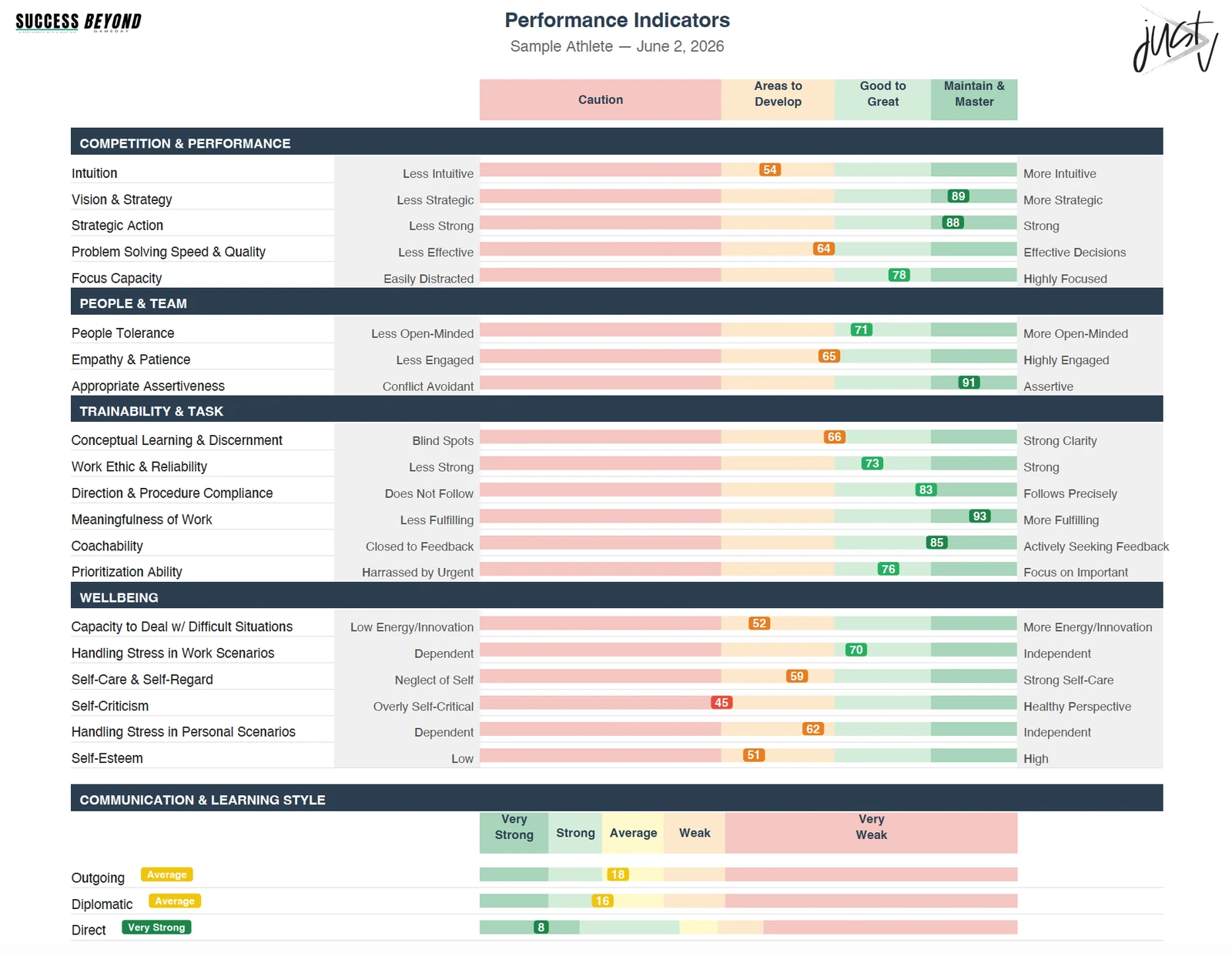
A sample Performance Indicators report.
Every athlete we assess receives a report like this — twenty Core Performance Behaviors scored and zoned, plus a separate communication and learning style profile. This is a sample; individual results and their implications are reviewed one-on-one.
From assessment to action
Findings translate into a private, individualized development plan — delivered and explained through a one-on-one consultation, not a self-serve report. That’s deliberate: the value is in the interpretation and the plan, not the raw score.
Frequently asked questions
Is this a personality test?
No. Generic personality assessments are typically only 50–60% accurate and rarely produce anything a coaching staff can act on. Our model is grounded in axiology — the study of how a person’s values shape behavior — and is designed around approximately 92% assessment accuracy.
How accurate is the assessment?
The model is designed around approximately 92% accuracy, scoring 20 core performance behaviors on a 0–100% scale across four zones: Caution, Areas to Develop, Good to Great, and Maintain & Master.
Can we see the assessment questions or scoring methodology before booking a consultation?
No. The underlying assessment, its questions, and its scoring formulas are proprietary and are not published. Results and their implications are reviewed one-on-one as part of a consultation.
Who administers the assessment?
Evaluators with direct, hands-on experience across professional football, multiple college sports, and elite high school recruiting — not a generic off-the-shelf testing service.
How is this different from combine testing or game film?
Combine numbers and film document physical and technical talent. This measures the behavioral and psychological factors underneath that talent — the factors that most often determine whether it translates into sustained performance, coachability, and team fit.